A flight with a stop can sometimes cost less than a direct journey. But not every connection works the same way.
Some itineraries are sold as a single journey, while others require you to arrange the connection yourself. This is known as a self-transfer.
Understanding the difference between a self-transfer and a regular connecting flight can help you avoid unexpected problems when planning an international trip.
What Is a Self-Transfer?
A self-transfer usually means you have separate flight tickets or bookings for different parts of your journey.
For example:
Dhaka → Kuala Lumpur
Kuala Lumpur → Bangkok
If these flights are booked separately, you may be responsible for making the connection yourself.
Depending on the airports and ticket conditions, you may need to collect your checked baggage, go through the required airport procedures, and check in again for the next flight.
That’s why a self-transfer should be treated differently from a normal connection.
How Is a Regular Connecting Flight Different?
With a regular connecting itinerary, the flights are generally arranged together under the same booking or ticket.
For example:
Dhaka → Doha → Paris
The airline or booking provider handles the itinerary as one journey according to the applicable ticket conditions.
If something goes wrong, such as a delay on the first flight, the protections and rebooking options depend on the ticket and airline’s rules.
With a self-transfer, the responsibility can be greater because the flights may be separate bookings.
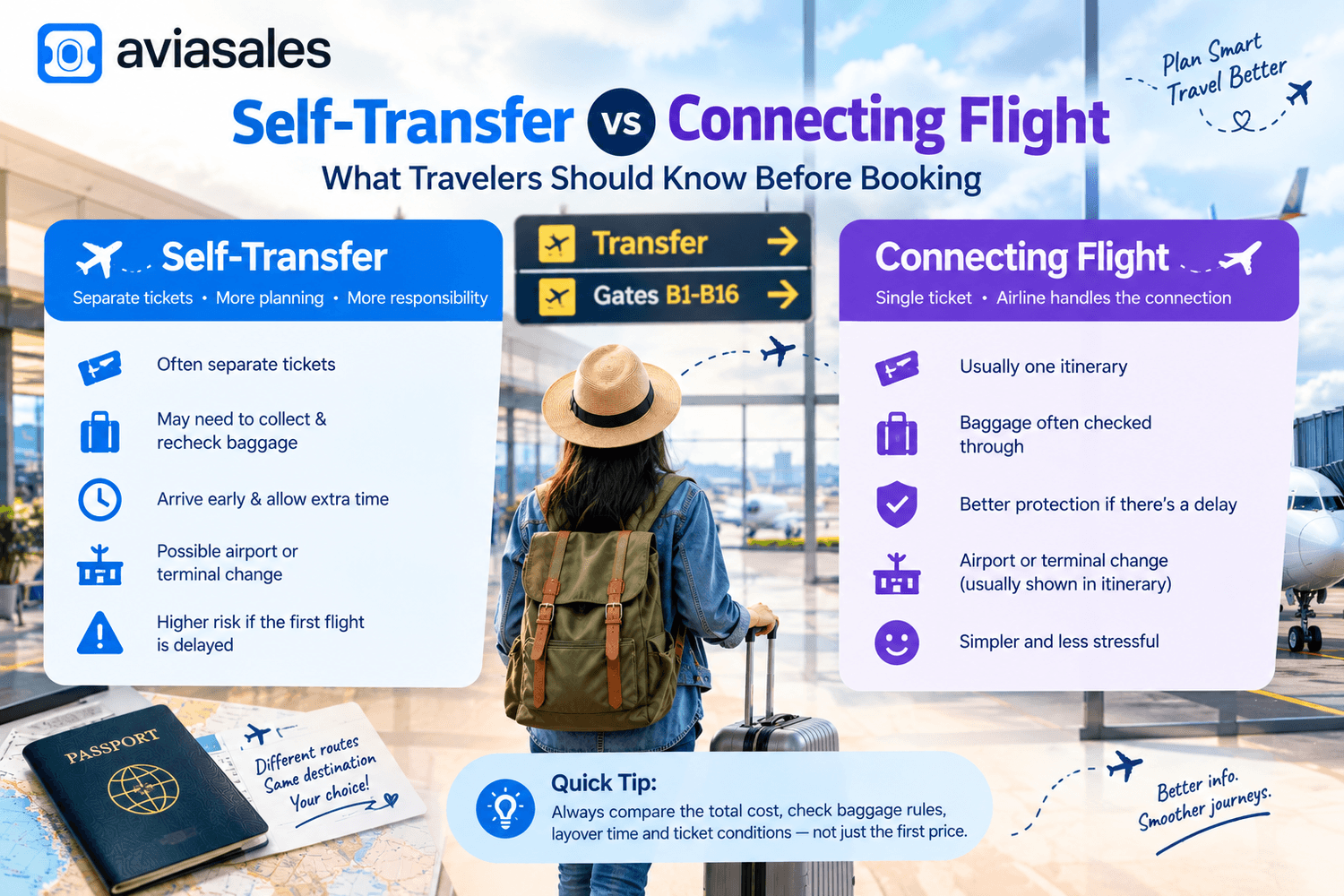
A quick comparison
| Feature | Self-Transfer | Regular Connection |
|---|---|---|
| Tickets | Often separate | Usually one itinerary |
| Baggage | May need re-checking | May be checked through |
| Missed connection | More responsibility on traveler | Depends on ticket conditions |
| Airport change | Possible | Usually shown in itinerary |
| Planning required | Higher | Usually simpler |
These are general differences. Always check the actual fare and airline conditions for your specific itinerary.
The Biggest Thing to Check: Your Baggage
Baggage can make a self-transfer more complicated.
If your first flight ends and your checked bag is not transferred automatically to the next flight, you may need to collect it and check it in again.
That can require extra time.
Before booking, check whether your baggage will be transferred automatically or whether you will need to handle it yourself.
If you are traveling with only carry-on luggage, the process may be simpler, but you still need to consider immigration, security, terminal changes, and check-in requirements where applicable.
Don’t Make the Layover Too Short
A self-transfer requires more planning than simply walking to another departure gate.
You may need time for:
- Immigration procedures
- Baggage collection
- Moving between terminals
- Airport security
- Finding the next check-in counter
- Rechecking baggage
- Possible delays on the first flight
For that reason, a very short connection can create unnecessary pressure.
A longer buffer may make the journey more manageable, especially when you are unfamiliar with the airport.
What Happens If the First Flight Is Delayed?
This is one of the most important differences.
Imagine you have two separate tickets:
Flight 1: Dhaka → Kuala Lumpur
Flight 2: Kuala Lumpur → Singapore
If Flight 1 is delayed and you miss Flight 2, the second ticket may have its own rules. You may need to contact the relevant airline or booking provider and arrange another flight yourself.
With a single itinerary, missed-connection handling may work differently under the ticket’s conditions.
So don’t compare self-transfer options based only on the lowest price.
When Can Self-Transfer Be Useful?
Self-transfer can be worth considering when the price difference is significant or when separate flights create a route that is not available as a convenient single itinerary.
It can also be useful for travelers who are comfortable with extra planning and have enough time between flights.
However, a cheaper itinerary is not automatically a better itinerary.
Consider the total cost, including baggage, airport transportation, possible overnight stays, and other additional expenses.
A Simple Example
Suppose you find two options:
Option A: One itinerary for $420
Option B: Self-transfer for $350
At first, Option B looks cheaper by $70.
But then you discover that the self-transfer requires extra baggage fees and a longer airport wait.
The actual difference may become much smaller.
This is why comparing the complete journey is more useful than comparing only the initial airfare.
How to Research Self-Transfer Options
When using Aviasales or another flight-search platform, pay attention to the complete itinerary rather than just the price.
Check:
Flights → Airports → Layover → Tickets → Baggage → Total cost → Booking conditions
If the flights are separate, make sure you understand what responsibility you have for making the connection.
Also check whether you need to change airports or terminals during the journey.
Before Booking a Self-Transfer
Use this quick checklist:
- Are the flights on separate tickets?
- Do you need to collect your baggage?
- Will you need to check in again?
- Are the airports or terminals different?
- Is the layover long enough?
- What happens if the first flight is delayed?
- Are there additional baggage or airport costs?
- Do you need to meet any entry or transit requirements?
These details can make a significant difference to the practicality of the itinerary.
Final Takeaway
Self-transfer flights can create interesting travel options, but they require more attention than a standard connecting itinerary.
Before booking, look beyond the airfare. Check baggage, airports, layover time, separate-ticket conditions, and what could happen if the first flight is delayed.
A slightly more expensive single itinerary may offer a simpler journey, while a self-transfer may suit travelers who are comfortable managing their own connection.
The key is to understand the itinerary before you book it.
Leave a Reply