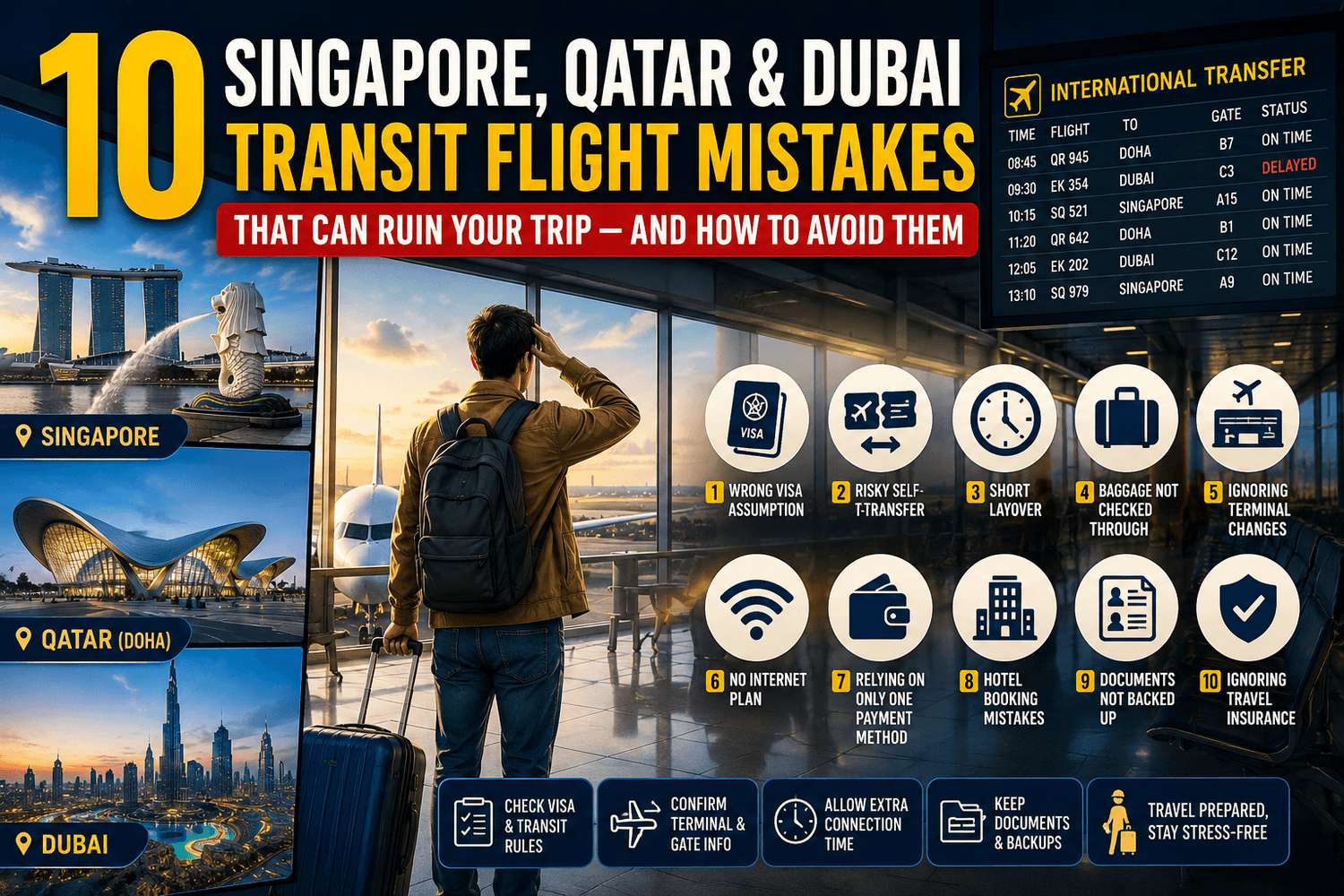
10 Singapore, Qatar & Dubai Transit Flight Mistakes That Can Ruin Your Trip — And How to Avoid Them
A cheap international flight can look like a great deal—until you realize you have a long transit, a terminal change, a baggage problem, or a document requirement you never checked.
For travelers flying through major hubs such as Singapore, Qatar, or Dubai, transit can be an easy part of the journey when planned correctly. But one small mistake can turn a simple connection into hours of stress.
This guide covers 10 common transit flight mistakes and how to avoid them, whether you are flying through Singapore, Doha, or Dubai.
Important: Transit and entry requirements can change. Always verify the latest requirements with the relevant airline, airport, and official government or immigration sources before traveling.
1. Assuming “Transit” Always Means You Don’t Need a Visa
This is one of the most dangerous assumptions travelers make.
People often think:
“I’m only changing planes, so I don’t need to worry about immigration or visas.”
That is not always true.
Whether you need a transit visa, entry permission, or other documentation can depend on your nationality, destination, airport, length of connection, terminal arrangements, baggage situation, and whether you need to pass through immigration.
The rules can also be different for Singapore, Qatar, and the UAE.
How to avoid it
Before booking your flight, check:
- Your passport requirements
- Transit requirements
- Whether you remain airside
- Whether you need to pass immigration
- Whether you need to collect your baggage
- Whether your connecting airport requires a terminal transfer
- Whether your final destination requires additional documents
Never rely on a social media comment or an old travel post for immigration rules.
2. Booking a Self-Transfer Without Understanding the Risk
A self-transfer can sometimes make a flight much cheaper.
For example, you may book:
Dhaka → Dubai
and separately:
Dubai → Europe
The problem is that these may be completely separate bookings.
If the first flight is delayed and you miss the second flight, the second airline may not be responsible for your missed connection.
You may also have to collect your baggage, leave the secure transit area, clear immigration, check in again, and go through security.
How to avoid it
Before booking separate tickets, find out:
- Whether baggage will be transferred
- Whether you need to enter the country
- Whether you need a visa
- How much connection time you actually have
- What happens if the first flight is delayed
- Whether you need to change terminals or airports
A flight that saves money but creates a risky connection may not actually be a bargain.
3. Choosing a Very Short Transit Time
A 90-minute connection can look perfect on a booking website.
But airports are not always predictable.
You may need to:
- Walk a long distance
- Take an airport train
- Pass transit security
- Change terminals
- Wait for a connection bus
- Deal with a delayed first flight
- Find your gate in a large airport
Major hubs such as Singapore, Doha, and Dubai can be busy and physically large.
How to avoid it
Do not choose a connection based only on the shortest possible time.
Consider:
Flight delay risk + airport size + terminal movement + transfer procedure + personal mobility + baggage arrangements.
If two flights have similar prices, a comfortable connection may be worth more than saving a little time.
4. Not Checking Whether Your Baggage Is Checked Through
This mistake can create serious problems during transit.
Some passengers assume:
“My luggage will automatically go to my final destination.”
That may be true on some itineraries—but not all.
Separate tickets, codeshare arrangements, airline combinations, and self-transfers can work differently.
How to avoid it
At the first airport, ask the airline:
“Is my baggage checked through to my final destination?”
Then check your baggage tag.
If the tag shows your final destination airport, that is a useful indication that the bag has been tagged through—but always follow the airline’s instructions.
If you need to collect your luggage during transit, you may need to go through additional procedures.
5. Ignoring Terminal Changes
You may see:
Arrival: Terminal A
Departure: Terminal B
and assume the terminals are next to each other.
They may not be.
Some airports have multiple terminals, different concourses, internal trains, shuttle buses, or separate procedures for transferring passengers.
Singapore
Singapore Changi Airport is known for its connected terminal system, but you should still check your specific flight, terminal, gate, and transfer instructions.
Doha
Hamad International Airport is a major international hub, and passengers may need to walk considerable distances between areas.
Dubai
Dubai International Airport has multiple terminals and transfer arrangements can vary depending on the airlines and itinerary.
How to avoid it
Before your trip, check:
- Arrival terminal
- Departure terminal
- Transfer route
- Gate information
- Minimum connection time
- Whether a terminal transfer is required
Do not wait until you land to start figuring this out.
6. Arriving Without Internet During Transit
Imagine landing after a long flight and discovering that your mobile data does not work.
You may need to check:
- Your next flight
- Gate changes
- Airport maps
- Airline messages
- Hotel information
- Transport details
- Digital travel documents
That is why internet access can be extremely useful during international travel.
How to avoid it
Before leaving home, consider arranging:
- Travel eSIM
- International roaming
- Airport Wi-Fi as a backup
- Offline maps
- Offline copies of important documents
If your phone supports eSIM, setting up a travel data plan before departure can make your arrival much easier.
7. Spending Your Transit Time in the Wrong Way
A long layover does not automatically mean you should leave the airport.
Some travelers see an 8–12 hour transit and immediately plan a city tour.
But leaving the airport can introduce additional requirements and risks.
You may need to consider:
- Entry requirements
- Immigration procedures
- Transportation time
- Airport return time
- Security screening
- Traffic
- Your next flight’s check-in requirements
How to avoid it
If you want to leave the airport during a long layover, first confirm that you are legally permitted to enter the country and that you have enough time for the complete round trip.
For a short layover, staying inside the airport may be the smarter choice.
8. Forgetting That Airport Security Happens Again
Some travelers think:
“I already passed security at my departure airport, so I’m done.”
Transit security procedures can vary by airport and itinerary.
You may have to go through another security screening before reaching your connecting gate.
Liquids, electronics, and other carry-on items can therefore become important.
How to avoid it
Keep your carry-on organized.
Place frequently inspected items where they are easy to access, and follow the security instructions at the transit airport.
Do not assume the security rules will be exactly the same as the airport you departed from.
9. Keeping Your Important Documents Only on Your Phone
A dead battery can become a serious problem if all your travel information exists only on your phone.
Imagine your phone runs out of power while you are trying to find:
- Your next flight
- Booking confirmation
- Hotel address
- Travel insurance
- Passport copy
- Emergency contact
How to avoid it
Keep important information in more than one format.
Carry your original passport and required documents, while also keeping secure digital copies of important records.
A power bank can also be useful during a long international journey.
For especially important information, having an offline copy can provide an extra layer of protection.
10. Not Confirming the Connection Before Leaving Home
This is perhaps the simplest mistake—and one of the most avoidable.
Travelers sometimes book a flight weeks or months in advance and never check the itinerary again until travel day.
Schedules can change.
Flight numbers can change.
Departure times can change.
Terminal information can change.
How to avoid it
Before leaving for the airport, review your complete itinerary:
Departure → Transit Airport → Connecting Flight → Final Destination
Check:
- Flight number
- Date
- Departure time
- Arrival time
- Connection time
- Terminal
- Baggage allowance
- Airline instructions
- Required travel documents
A five-minute check before leaving home can prevent hours of confusion later.
Singapore vs Qatar vs Dubai Transit: What Should You Pay Attention To?
Each major hub can offer a different transit experience.
🇸🇬 Singapore Transit
Pay particular attention to:
- Your terminal and transfer route
- Whether you remain in the transit area
- Baggage arrangements
- Connection time
- Any entry requirements if you plan to leave the airport
Singapore is often used as a major connecting hub for travelers heading toward Southeast Asia, Australia, and other international destinations.
🇶🇦 Qatar Transit
For travelers connecting through Doha, pay attention to:
- Connection time
- Transfer directions
- Terminal/gate information
- Baggage arrangements
- Transit and entry requirements
- Airline-specific instructions
Doha is a major connecting point between Asia, the Middle East, Europe, Africa, and the Americas.
🇦🇪 Dubai Transit
For Dubai connections, pay particular attention to:
- Which Dubai airport your flight uses
- Terminal information
- Airline combination
- Baggage transfer
- Whether your itinerary is a single booking or separate tickets
- Immigration requirements if you need to leave the airport
Do not assume every Dubai flight connection works the same way.
The Golden Rule of International Transit
Before booking a transit flight, ask yourself five questions:
1. Do I need a visa or other permission for transit?
2. Will my baggage go directly to my final destination?
3. Do I need to change terminals?
4. Is my connection time comfortable?
5. What happens if my first flight is delayed?
If you cannot answer these questions, do not book the flight yet.
Take a few minutes to verify the details.
Smart Transit Checklist
Save this checklist before your next international flight:
☐ Passport validity checked
☐ Visa requirements checked
☐ Transit requirements checked
☐ Flight itinerary confirmed
☐ Connecting flight confirmed
☐ Baggage transfer confirmed
☐ Terminal information checked
☐ Connection time reviewed
☐ eSIM/mobile data prepared
☐ Important documents backed up
☐ Payment method prepared
☐ Airport transfer researched if leaving the airport
☐ Airline contact information saved
☐ Power bank charged
Final Thoughts
A transit flight does not have to be stressful.
The key is understanding that a connecting flight is not just two flights—it is one complete journey with several moving parts.
Singapore, Doha, and Dubai are major international aviation hubs, but every itinerary is different.
The smartest traveler is not necessarily the person who finds the absolute cheapest ticket.
It is the person who understands the total journey before clicking “Book.”
Check your documents. Understand your baggage arrangements. Give yourself enough connection time. Prepare your internet access. Know your terminals. And most importantly, verify the latest transit requirements before you travel.
A few minutes of preparation can save you from hours of unnecessary stress.
Travel smarter. Connect with confidence. Explore more with Nova Travel BD.
Leave a Reply